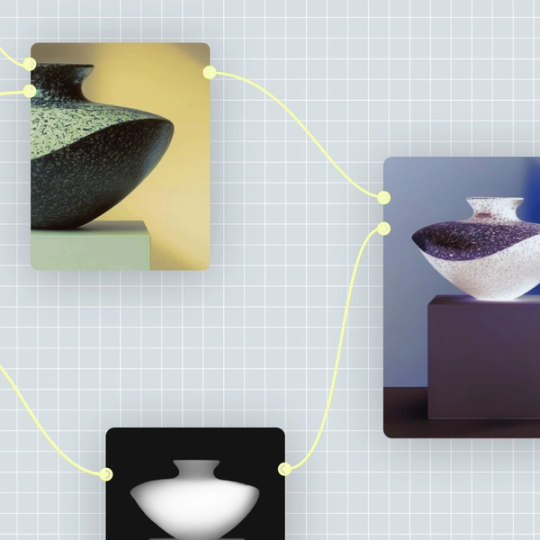
AI moodboard generator

Generate, curate, and refine visual direction—all on one canvas.

Build visual direction that scales with your process

Weave connects moodboard generation to the rest of your creative pipeline. Pull references, generate variations, and refine direction without switching tools—keeping your visual strategy in one connected workspace.

  • Every AI model for visual exploration

    Access image generators from Google, Stable Diffusion, Recraft, and more—all from one canvas. Generate references in different styles, test color palettes, and explore aesthetic directions without juggling separate subscriptions.

  • Let teams explore without the setup

    Creative directors build the moodboard workflow once. Team members add a brief and generate visual directions immediately—no need to understand the underlying node setup or rebuild it each time.

  • Refine direction with professional tools

    Go beyond generation. Color grade, composite, and adjust references directly on the canvas. The same editing tools professionals rely on, connected to your AI-generated imagery—no export required.

  • See every creative decision on canvas

    Build your moodboard as a visible workflow—references, generations, and refinements all connected. Trace how your visual direction evolved and revisit decisions without digging through folders.

How to generate moodboards in Figma Weave

Connect to the AI image models that fit your visual direction—photorealistic, illustrated, abstract, or mixed. Access multiple providers in one workflow to explore different aesthetic territories.

Add nodes for style references, color extraction, and composition. Layer in editing steps to refine generated images—crop, color grade, or composite before they hit your board.

Run your workflow, review the outputs, and keep what resonates. Adjust prompts, swap models, or refine individual images. Your moodboard evolves through iteration, not a single generation.

Built by our community

See how the Figma Community is using Figma Weave to create AI-generated images, video, and 3D.

FAQ

Yes. Figma Weave connects you to multiple AI image models that can generate visual references, color palettes, and aesthetic explorations. You guide the direction through prompts and references, then curate and refine the output on the same canvas.

Build a workflow that matches your process. In Weave, you connect generation models to editing tools—so you can generate options, refine them, and curate your board without switching between separate apps. The node-based canvas keeps every decision visible and adjustable.

You can get started with Figma Weave for free. The free tier gives you access to AI models and the node-based canvas for building moodboards. Advanced features and higher usage are available on paid plans.

Weave gives you access to major AI image models including Google, Stable Diffusion, Recraft, and Bria—all from the same canvas. You can use different models for different parts of your moodboard workflow without managing separate subscriptions.

Yes. Weave workflows are reusable systems. Build your moodboard generation process once, then run it with different briefs, references, or style inputs for each new project. Your creative setup scales without rebuilding from scratch.

Yes. You can share workflows with a simplified interface so team members add their inputs and generate moodboard options—without needing to understand or rebuild the underlying node graph. Creative logic stays consistent across the team.

Become an agent expert

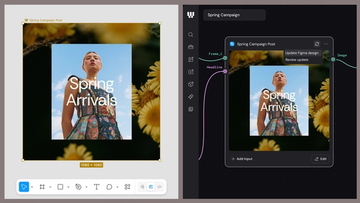
A “Spring Arrivals” campaign design shown in Figma Design beside its connected Figma node in Weave, with options to update the Figma design or review an update.A “Spring Arrivals” campaign design shown in Figma Design beside its connected Figma node in Weave, with options to update the Figma design or review an update.

The TL;DR on Figma Weave: Make your creative process repeatable

Figma Weave brings AI generation and editing tools together into connected, reusable workflows, giving you a process your team can shape, refine, and repeat. Here’s what it unlocks for creative teams and how to get the most out of it.

Learn more

Workflow lab: From design system to campaign in Figma Weave

Design systems can power more than just designs. This workflow shows you how to turn raw materials into brand campaign collateral using the Gen Effect and Figma nodes.

Learn more
Colorful abstract illustration of interlocking geometric shapes, including loops, arrows, a starburst, and grid patterns, suggesting connected tools and workflows.Colorful abstract illustration of interlocking geometric shapes, including loops, arrows, a starburst, and grid patterns, suggesting connected tools and workflows.

Try these 5 Weave tools—and share your own

Community publishing is now live for Weave tools. Here are a few tools that stand out, from turning a moodboard into a realistic room mockup to previewing your next nail set.

Learn more
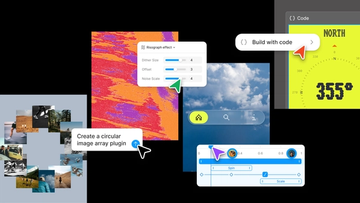
Collage-style product graphic showcasing AI-assisted design and development workflows, with plugin creation prompts, visual effect controls, code generation tools, and interactive UI components arranged across a creative workspace.Collage-style product graphic showcasing AI-assisted design and development workflows, with plugin creation prompts, visual effect controls, code generation tools, and interactive UI components arranged across a creative workspace.

Config 2026: New materials, new tools and a more expressive canvas

Push past what you thought was possible with code layers, Figma Motion, shaders, generative plugins and Weave tools, all on the canvas.

Learn more
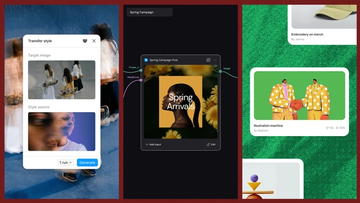
Three-panel product graphic demonstrating AI-powered style transfer. On the left, a "Transfer style" interface displays a target image of people carrying skateboards and a blurred portrait used as the style source. In the center, a workflow canvas labeled "Spring Campaign" shows a connected post-generation node producing a floral-themed social media graphic titled "Spring Arrivals." On the right, a gallery-style layout displays generated creative assets, including an illustrated handshake artwork and merchandise design cards, showing how transferred styles can be applied across a campaign.Three-panel product graphic demonstrating AI-powered style transfer. On the left, a "Transfer style" interface displays a target image of people carrying skateboards and a blurred portrait used as the style source. In the center, a workflow canvas labeled "Spring Campaign" shows a connected post-generation node producing a floral-themed social media graphic titled "Spring Arrivals." On the right, a gallery-style layout displays generated creative assets, including an illustrated handshake artwork and merchandise design cards, showing how transferred styles can be applied across a campaign.

Connecting Figma and Weave

Today, we’re announcing new ways your Weave creative workflows can live alongside your Figma frames.

Learn more

Direct every frame with Runway Aleph 2.0, now in Figma Weave

Aleph 2.0 brings frame-level creative direction to the Figma Weave canvas.

Learn more
Powered by Fruition