How Theodo reinvents the product workflow with Figma
A luxury brand commissioned Theodo to redesign its clienteling app, key to delivering a high-quality experience and a personalized customer relationship. The experience provided by existing ecosystems fell short of market standards and was impacting the quality of interactions. Theodo drew on design and AI to create a tool capable of streamlining the in-store experience for both staff and customers. The agency thus enabled its client to explore an approach that could speed up the design process and rapidly test new versions in the field.
Reducing legacy ahead of the overhaul
Over seven years, the application had become difficult to manage: 260 screens, more than 40 connected third-party systems, and business rules spanning three sectors and several regions. As a result, the adoption rate was stuck at 20%, capabilities were under-utilized, and it took seven months to deliver a new feature. The challenge was both technical and human. The teams spent a great deal of time analyzing the existing code for fear of upsetting a delicate balance, which represented a massive opportunity cost for the company. Faced with this, they made a strategic decision: to move away from a monolithic application in favour of a modern architecture, comprising robust backend services, shared capabilities and specialised, business-specific applications.
Retrieving the source of truth with the agent factory
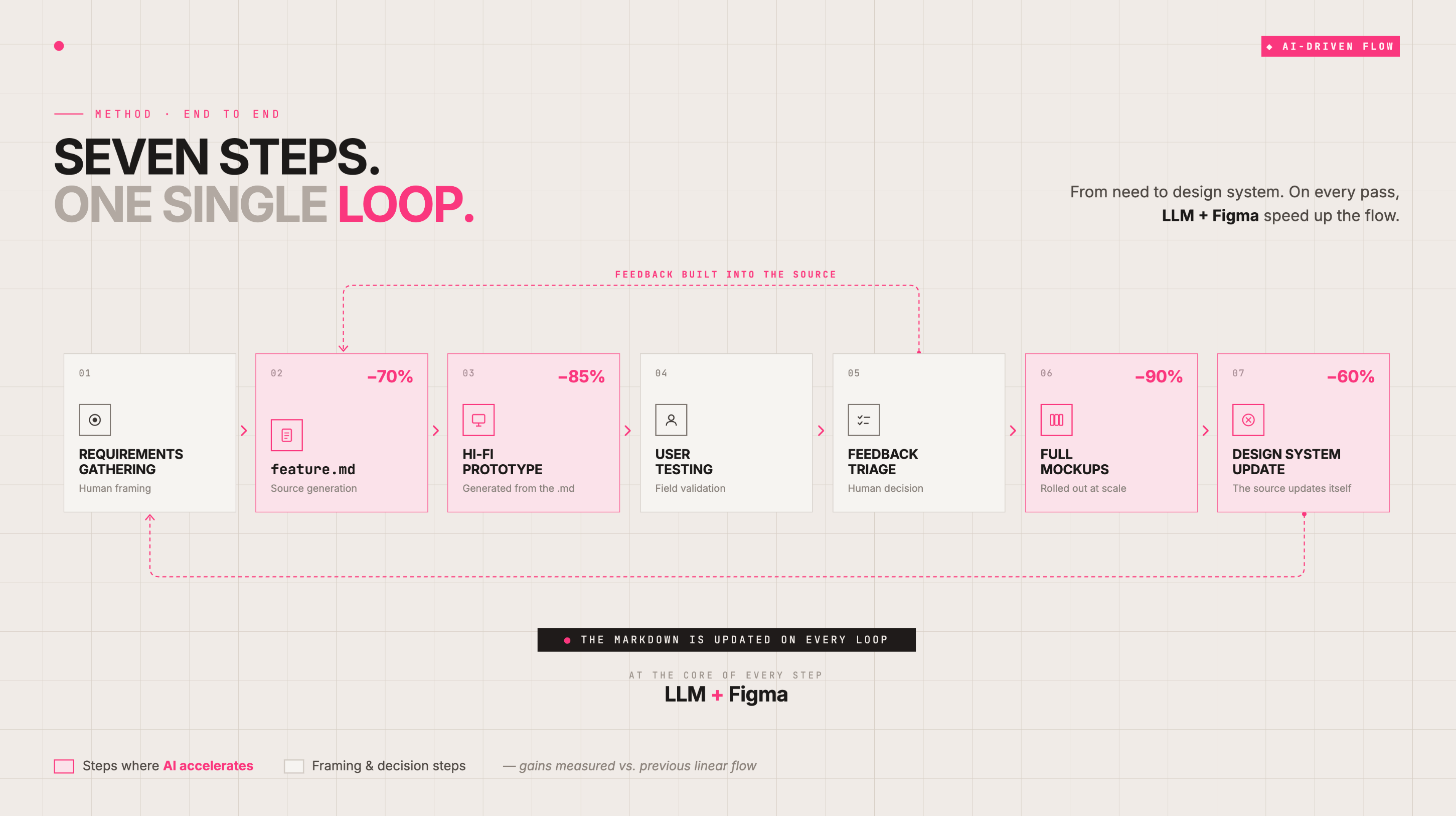
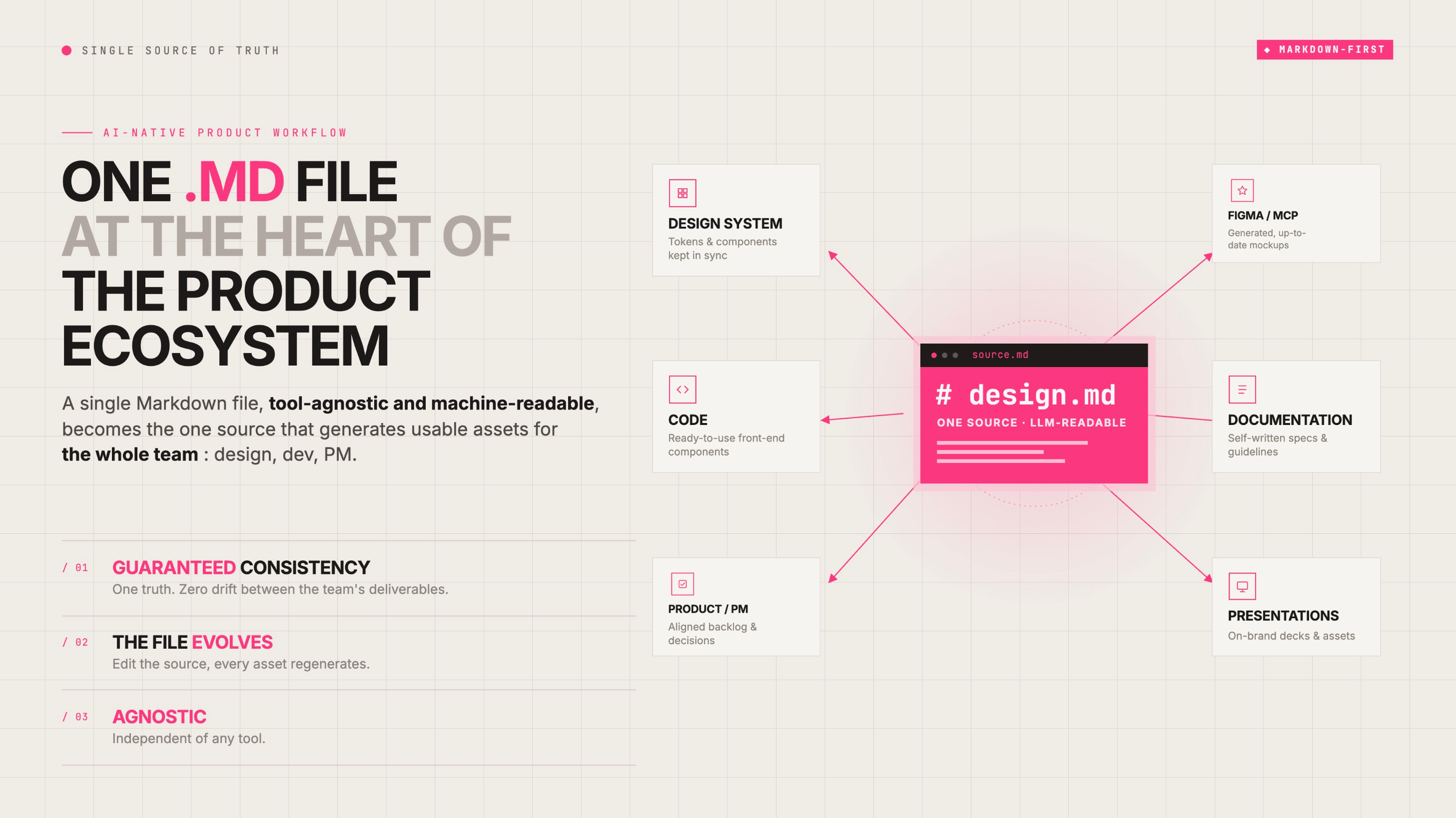
Before reinventing the tools, the knowledge had to be secured. Theodo deployed an agent factory to retro-document the existing system: the AI scanned the source code, the Jira history and the user guides, then consolidated everything into a structured database of Markdown files (a simple, lightweight text format that is easily readable by both humans and machines).
Building and validating prototypes quickly with Figma Make
By integrating Figma into their workflow, teams have reduced their design and delivery cycle by two-thirds, going from six weeks to two. But the aim isn’t just to work faster: it’s above all about designing better, with every iteration. No more abstract wireframes and placeholder text: with Figma Make, requirements structured in Markdown are transformed almost instantly into high-fidelity prototypes, with complete user flows, real data and edge case handling included right from the very first versions.
Above all, this maturity takes the conversation wherever it creates value. No more abstract debates over unclear wireframes: business stakeholders immediately get to grips with the product logic, make decisions based on what they see working, and resolve the real issues at an early stage. Collective energy is focused on what truly shapes the experience.
“Actually, AI is making us rethink our role as designers. The right balance is to outsource the tasks that take up our time without really helping us think through things, and to keep the ones that fuel our understanding and creativity.”
— Théo Lopez Carbajal, Lead AI Product Builder, Theodo
Scaling up with Figma’s MCP server and Code Connect
To sustain this pace, Theodo opted for scaling up via Figma’s MCP server: this technical bridge allows AI to navigate the Figma architecture precisely using Node IDs (unique identifiers for each element) and functions such as Get Design Context. The design system thus becomes a product in itself, with full synchronisation between Figma tokens and React components in production.
With Code Connect, code snippets linked to the GitHub repository are displayed directly within Figma’s Dev Tools. This ensures consistency between the design intent and the final output, avoiding technical debt associated with manual reinterpretations. By analyzing the component structure and their variants, the AI generates code that complies with accessibility standards and atomic design principles. Therefore, each component remains perfectly aligned across its Storybook and Figma Design file.
Enhancing human expertise and design governance
The success of these innovations now requires a new approach to structuring design across the organisation. Far from automating creativity, AI demands precise governance. The role of designers centres on their primary function: providing direction. As technical experimentation has shown, AI tends to generate "hallucinations". Before using these tools and models, aligning teams and structure knowledge is necessary to ensure easy exploitation. The maturity of the organisation therefore determines the success of an AI-enhanced workflow.
“A method gains traction when every team recognises its value. We need leaders who demonstrate how to apply it, share their learnings, and prove its impact with figures.”
— Théo Lopez Carbajal, Lead AI Product Builder, Theodo
By tripling productivity, this transformation puts the designer back at the heart of the strategy. The designer sets the rules, oversees the agent-based factory and ensures brand experience consistency. AI thus supports an expanded human vision and enables luxury houses to stay agile as technology evolves, whilst maintaining their high operational standards.
Published on October 27, 2026
See how Figma can help you scale design
Get in touch to learn more about how Figma can help companies scale design.
See how Figma can help you scale design
Great design has the potential to differentiate your product and brand. But nothing great is made alone. Figma brings product teams together in a fast and more inclusive design workflow.
Get in touch to learn more about how Figma can help companies scale design.
We’ll cover how Figma can help:
- Bring every step of the design process—from ideation, to creation, to building designs—into one place
- Accelerate design workflows with shared company-wide design systems
- Foster inclusivity in the product team process with products that are web-based, accessible, and easy to use