How Eternal uses Figma to build one design language across four different businesses
Eternal (formerly Zomato) is a new-age tech organiser in India that has a line of businesses across diverse verticals, including food delivery (Zomato), quick commerce (Blinkit), going-out offerings (District), and B2B supplies (Hyperpure). These platforms have become part of daily life for over 100 million customers in the country. They also support the livelihoods of over 1 million delivery partners, 400,000+ restaurants, 100,000+ supply chain workers and thousands of brands.
Building for scale
Before ‘Eternal’ existed as a name, Zomato’s design team found themselves faced with the challenge of keeping their design files in sync and up to date. With the onset of the pandemic in 2020 and teams working from home, there was also a need for a more collaborative way of working together
Moving the team to Figma transformed how they worked. With shared components, built-in versioning, and organisation-wide visibility, Figma became their single source of truth—allowing designers to move faster and giving engineers earlier access to what they needed.
“When I (joined) Eternal, I was quite amazed at how deeply Figma was integrated into almost everything,” shares Joy Banerjee, VP, Design, Blinkit. “For publications, for investor reports, even teams using it for internal communications. Figma is always open, everyday.”
Prototyping what a static screen can't show
On Zomato, one of the clearest examples is the app's voice ordering assistant, an AI-driven chatbot that lets customers navigate the app hands-free, when discovering restaurants, dishes, browsing menus, and placing an order.
"This was a particularly useful problem to prototype because the experience doesn't live on one screen," says Priyanka Srinivasagopalan, Design Lead, Zomato. "It moves across the entire app, and much of the design is about conversation, timing, and behaviour."
Creating just static mockups alone wouldn’t cut it, as these were limited in allowing the design team to understand how truly immersive and natural the voice ordering experience would be.
To solve this, the Zomato team tapped on Figma’s suite of products. Figma Motion was used to create wave-like animations that would move when the user said something, while the team also used canvas agents to create variations of the design. The team also plugged into the Figma MCP server to send the coded build back to canvas, to experience the product before making final decisions.
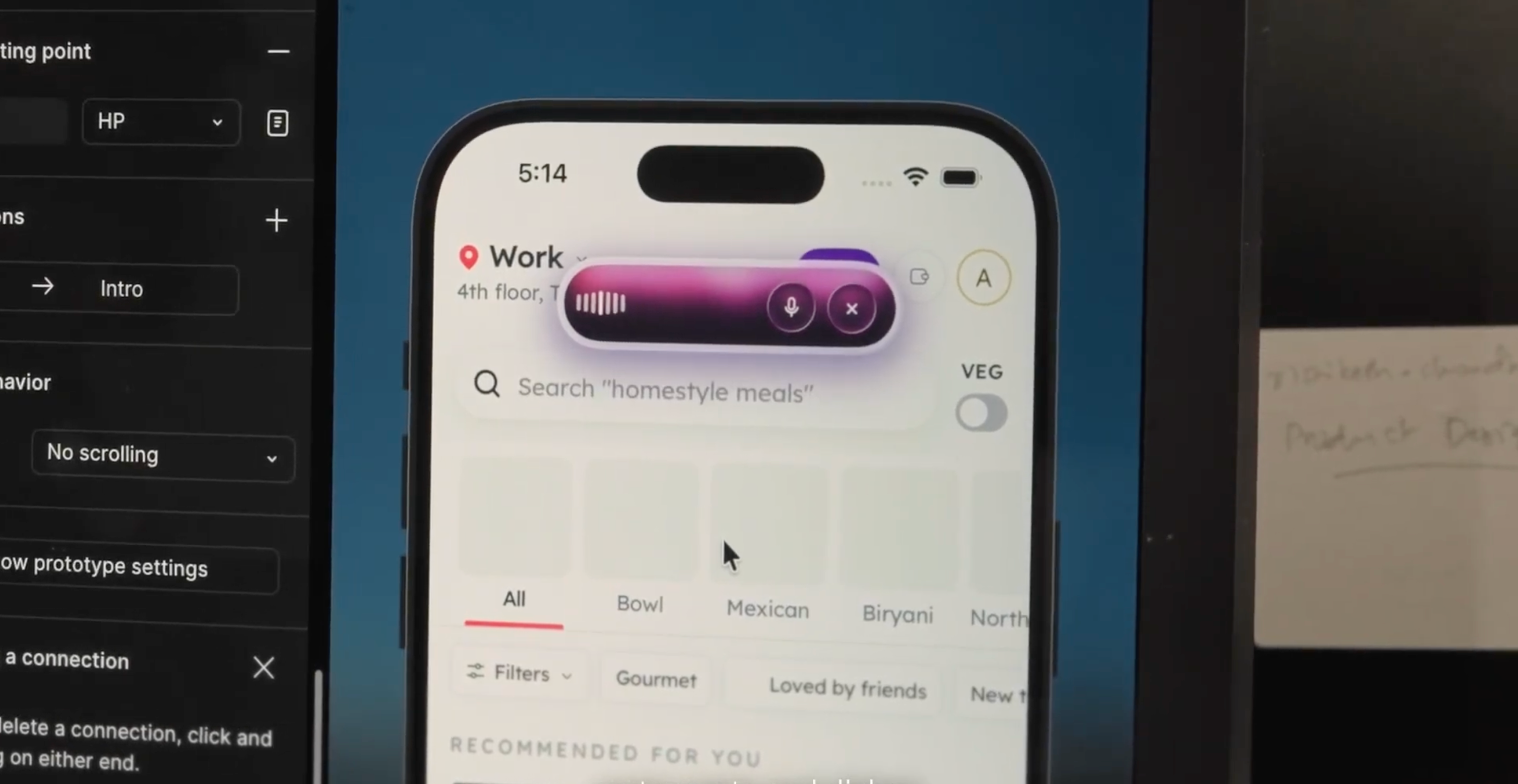
“All of these products across Figma allowed us to bring together a design that we could ship with confidence, at a speed we couldn’t imagine before, because we were creating 10 variations of designs in the span of time which would have otherwise taken us to create just one,” says Priyanka.
Anmol Arora, Design Lead for District, shares the same sentiment. Watching someone click through a working prototype, rather than review static screens, changes the feedback the team gets: "(Stakeholders) are able to understand the flow better. So this helps us (designers) make decisions faster."
Once a working prototype is created and approved, the team then layers in the Figma MCP server to pull in District’s actual components and design language, turning a validated idea into something closer to the shipped production app. Anmol calls the combination "the biggest unlock": going from a rough wireframe, or a single prompt, to a working prototype in minutes. It's also no longer just a designer's tool — "even PMs and engineers can start building their ideas in Figma and then show it to people."
Creating new ideas quicker, with Figma Make
When it comes to building prototypes, the Eternal team has also tapped on Figma Make to visualise their creative ideas quickly. For instance, the design team for District wanted to work on a new feature where customers could choose their ‘vibe of the day’, and be presented with a cluster of events relevant to their choice.
What started as a fuzzy idea was turned into a prototype quickly. "We just started with Figma Make, built a quick prototype, and then showed it to people,” says Anmol. From there, the team then plugged into the Figma MCP to polish the prototype into something real and app-like.
Before, that kind of complex, animated prototype used to take days to polish. Now, prototypes that took about five days take a couple of hours — a shift that has changed the way and how we experiment every day, shares Anmol.
Supporting growth and the way forward
The way Eternal uses Figma goes well beyond design and engineering. Today, Figma has become a shared space for capturing and negotiating product intent. "Figma is always open, every day,” says Joy Banerjee, VP, Design, Blinkit.
Gyanendra Kumar, VP, Engineering, Zomato, sums it up: "When you are building a digital ecosystem which is as vast as Eternal, you need a support system that is fast, collaborative and efficient. For us, Figma has become that digital support system, helping the entire organisation build, collaborate, and ship things faster."
See how Figma can help you scale design
Get in touch to learn more about how Figma can help companies scale design.
See how Figma can help you scale design
Great design has the potential to differentiate your product and brand. But nothing great is made alone. Figma brings product teams together in a fast and more inclusive design workflow.
Get in touch to learn more about how Figma can help companies scale design.
We’ll cover how Figma can help:
- Bring every step of the design process—from ideation, to creation, to building designs—into one place
- Accelerate design workflows with shared company-wide design systems
- Foster inclusivity in the product team process with products that are web-based, accessible, and easy to use